
KNOWLEDGE HUB

If you have spent any time looking at your child's genetic test report, you have likely encountered a wall of intimidating words: missense, frameshift, splice-site, or deletion. These terms can feel like a secret language designed to keep you from understanding what is actually happening. It is completely natural to feel overwhelmed, but learning the "type" of genetic change is a powerful step. It helps you move past the jargon so you can ask your clinical team deeper questions about how this change might affect your child’s health.
Knowing the type of variant is like knowing if a car isn't running because it’s out of gas, has a flat tire, or has a broken engine. The "fix" and the "outlook" depend entirely on the specific problem. This guide will walk you through these common terms in plain language, helping you understand the mechanism behind the results.
Where Do I Find the Variant Type In the Report?
When you look at a lab report, your eyes will likely be drawn to a specific line of text that looks like a string of code. This is the variant line. You will typically see the name of the gene (like SCN1A or KMT2A), followed by two different notations. One usually starts with a "c." (the coding or DNA level) and another starts with a "p." (the protein level).
Nearby, the lab will list the classification, such as Pathogenic, Likely Pathogenic, Benign or Variant of Uncertain Significance (VUS). Right next to or just below this, the report will specify the variant type. This is the label that tells scientists exactly what kind of "typo" occurred in the genetic instructions.
The most important reason to understand the type of variant is that it often hints at the disease mechanism. In genetics, we aren't just looking at if a gene is different; we are looking at how that difference affects the body. Most genetic conditions happen because of one of two main "mechanisms":
In many cases, a genetic change causes a loss-of-function (LOF), which simply means the gene is not working enough or is missing entirely. Imagine a factory that is supposed to produce 100 essential parts a day, but because of a mistake in the manual, it only produces 50. The body is left without enough of what it needs to function correctly.
Other changes lead to a gain-of-function (GOF), where the gene becomes too active or the protein it codes starts doing something entirely new and unhelpful. Sometimes, a mutation can create a "dominant negative" effect, where the faulty protein actually interferes with the healthy proteins, like one broken wheel on a cart that stops the other three from turning.
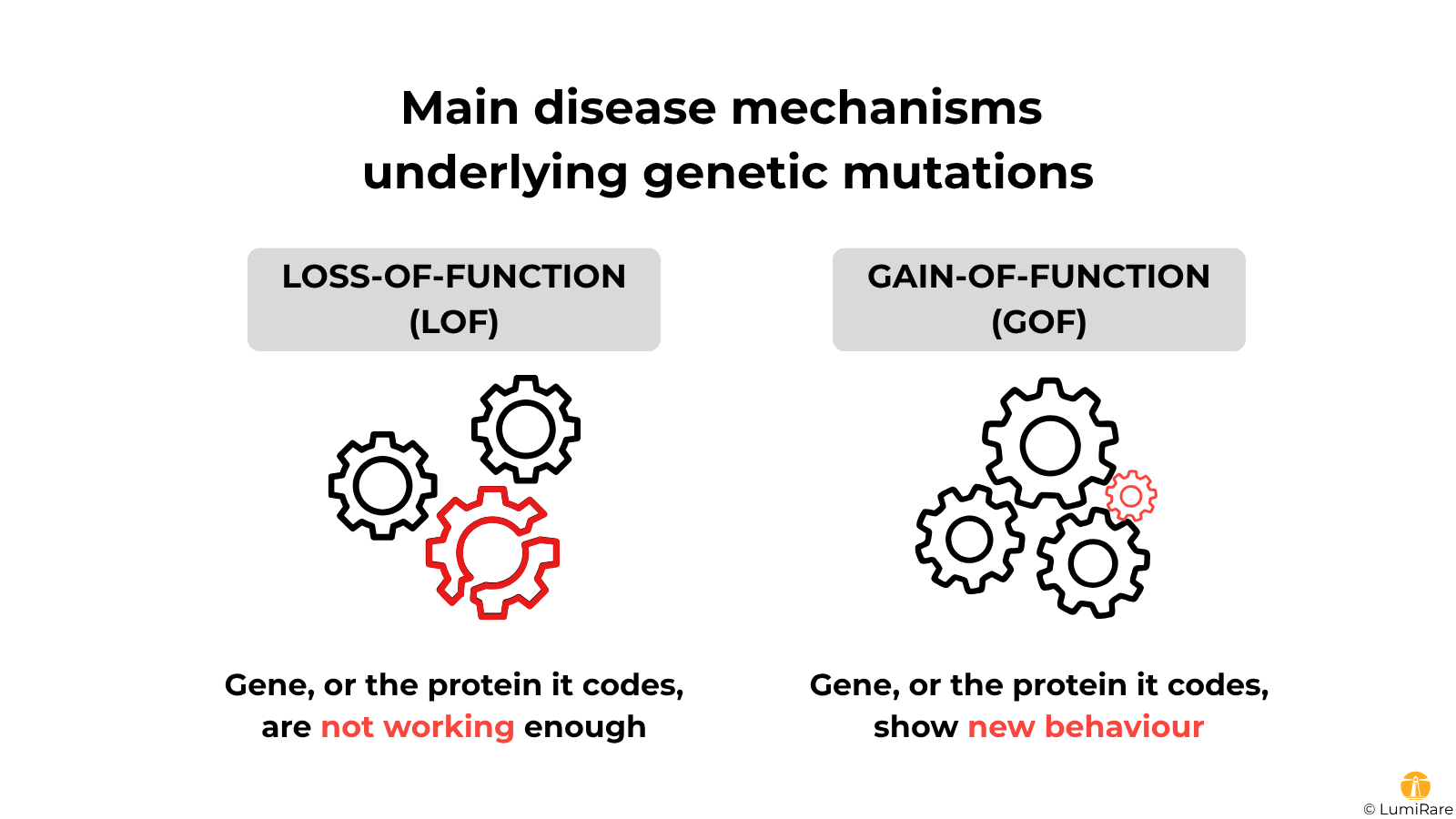
The type of variant listed on your report is the first big clue for your doctor to figure out which of these mechanisms is at play.
Every genetic change is unique, but most fall into a few well-known categories. Understanding which category your child’s variant belongs to can help you visualize what is happening inside their cells.
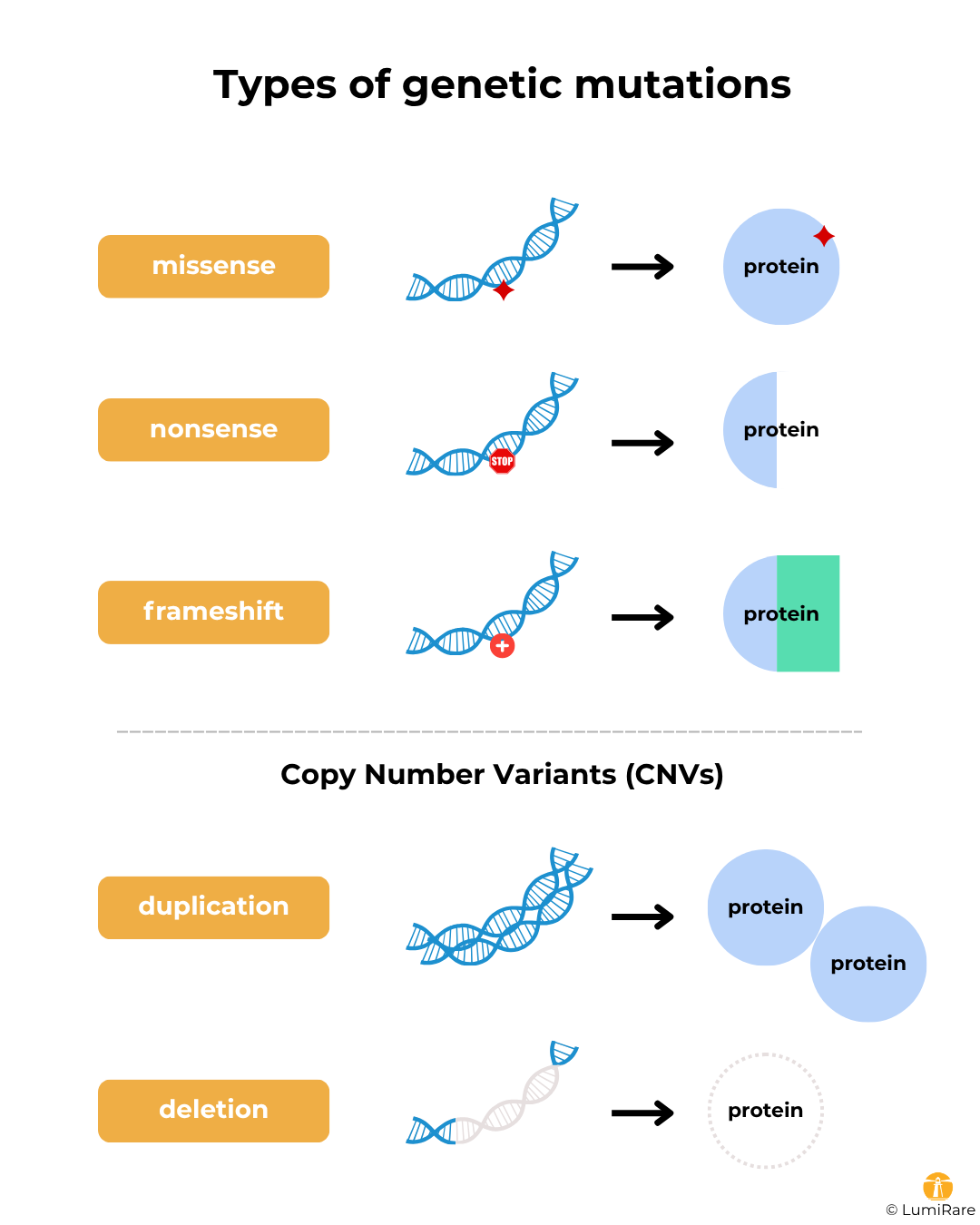
A missense mutation is often described as a single-letter swap. If you think of a gene as a sentence, a missense mutation changes just one "letter" (a nucleotide) in that sentence. This is one of the most common types of changes.
Because it only changes one small part, the body still makes the protein that the gene codes, but it might not work perfectly. Think of it like a key that is the right shape but has one jagged edge filed down, it might still open the lock with some struggling, or it might not work at all. Missense variants can lead to either a loss of function or a gain of function, which is why they are often labeled as a VUS until more research is done.
These are often called "truncating" variants because they usually cut short the protein that the gene codes.
Both of these types usually lead to a loss-of-function because the resulting protein is either destroyed by the cell or is too short to do any work.
Genes are made of sections that need to be "cut and pasted" together correctly to work. This process is called splicing. A splice-site variant is like a mistake in the editing room. If the cell cuts the instructions in the wrong place, it might leave out an important chapter or include a section of "junk" data that shouldn't be there. These changes can be very unpredictable and often require special testing to understand.
While the types above are small "spelling" mistakes, Copy Number Variants (CNVs) are larger changes.
If a deletion happens, the body usually suffers from a loss-of-function (not enough protein). If a duplication happens, the body might produce too much of a protein, which can be just as disruptive as having too little.
How Types Link to Disease Mechanism
When your geneticist looks at the report, they are mentally mapping the variant type to how they expect the disease to act. While there are always exceptions, scientists use these general patterns:
Understanding this is helpful because it explains why some treatments might work for one child but not another, even if they have a mutation in the same gene.
Your next appointment is a great time to move beyond the label and ask about the biology. Here are a few practical questions you can use to start that conversation:
A Final Thought
The terms on a genetic report can feel cold and clinical, but they are simply the labels we use to describe the unique way your child’s body is built. Whether the change is a missense "swap" or a frameshift "shift," knowing the type is your first step toward finding a clearer path forward.
As the science of genetics continues to advance, we are getting better every day at understanding exactly how these different "typos" lead to the symptoms we see.
Badonyi M, Marsh JA. Prevalence of loss-of-function, gain-of-function and dominant-negative mechanisms across genetic disease phenotypes. Nat Commun. 2025;16:8392. doi:10.1038/s41467-025-63234-3.
This text was written by the LumiRare team – researchers specialising in rare diseases.
This content is for educational purposes only; it does not constitute medical advice.
Would you like to find out what science has to say about your genetic finding?
LumiRare’s researchers analyse scientific articles and highlight what may be most relevant to your situation.

FOLLOW FOR RARE DISEASE
RESEARCH UPDATES